.avif)
Why Most Hardware Startups Fail (and How to Avoid It)
Most hardware startups don’t fail because of one big mistake.
They fail because a handful of critical questions were never properly answered, or were answered too late, when changing course became expensive.
Unlike software, hardware locks in decisions early. Materials, tooling, manufacturing, supply chains, each choice compounds. If the foundations aren’t right, progress becomes harder, slower, and more costly to fix.
Across projects, the same gaps show up again and again.
At the centre of it are five questions every hardware startup needs to answer.
And while hardware is often seen as complex and high-risk, it doesn’t have to be.
With the right understanding of how to build a viable product and a sustainable business around it, many of the common reasons for failure can be avoided early, before they become expensive to fix.
1. What product DNA will succeed?
This is where most teams go wrong first.
In hardware, product DNA isn’t just about what the product does. It’s about how well it is suited to the environment it’s entering.
The market is an ecosystem, shaped by user behaviour, expectations, price sensitivity, competitors, and context of use. For a product to succeed, it needs the specific DNA that allows it to survive and thrive within that environment.
That means not just performing well in isolation, but holding up across real-world constraints, cost, durability, usability, user perception, manufacturability, in a way that fits naturally into that landscape.
We often see teams optimise for one dimension (performance, aesthetics, or novelty) while unintentionally compromising others that matter more at scale.
Product DNA is the intersection of desirability, feasibility, and viability and in hardware, those tensions are physical, not theoretical.
What to do instead
Define your constraints as clearly as your ambitions:
- What conditions must this product survive? (environmental, usage, lifecycle)
- What is the target market, how big is it, how much are they willing to pay?
- What is the problem we are trying to solve and is it one worth solving?
Then design within those constraints, not around them.

2. How will this return investment?
This isn’t just about costs, it’s about whether there’s a viable business here at all.
Too often, teams treat the product and the business model as separate problems. They design something compelling first, then try to work out how it makes money later.
In hardware, that separation doesn’t hold. The business model shapes the product.
Early questions should include:
- Who exactly is this for?
- How large is that market, realistically?
- What are they willing to pay not ideally, but in reality?
- Is this a high-margin, low-volume product, or a lower-margin product that relies on scale?
- What is the business model, direct-to-consumer, B2B, rental, subscription, or something hybrid?
Each of these decisions has direct design implications.
For example, your business model alone will reshape the product:
- A D2C product may need stronger brand expression, packaging, and out-of-box experience
- A B2B product may prioritise reliability, serviceability, and integration into existing systems
- A rental or subscription model may require durability, easy maintenance, and modular repair
We often see teams miss this link, designing a product that doesn’t align with how it needs to perform commercially.
What to do instead
Think about the business as early as the product:
- Define your target segment clearly (not broadly)
- Sense-check market size and accessibility
- Test pricing expectations before locking specifications
- Understand how cost, margin, and volume interact
Then let those insights shape design decisions from the start.
A strong hardware product is designed to work as a business.
3. Are there better design options?
This is fundamentally about solution bias, committing to an answer before properly exploring the problem space.
It’s a natural instinct. A solution emerges, it feels promising, and momentum builds around it. But in hardware, that early commitment can lock teams into a path that hasn’t been properly challenged.
Once CAD is developed, prototypes are built, and especially once tooling begins, the cost of change increases rapidly. What started as a “good idea” becomes the default, not because it’s the best option, but because it’s the furthest developed.
We regularly see teams move forward without fully considering:
- Alternative architectures (is there a simpler way to achieve the same outcome?)
- Different mechanisms or interactions
- Manufacturing approaches that could reduce cost or complexity
The issue isn’t that the chosen solution doesn’t work. It’s that it hasn’t been earned through comparison.
What to do instead
Create space to explore before you commit:
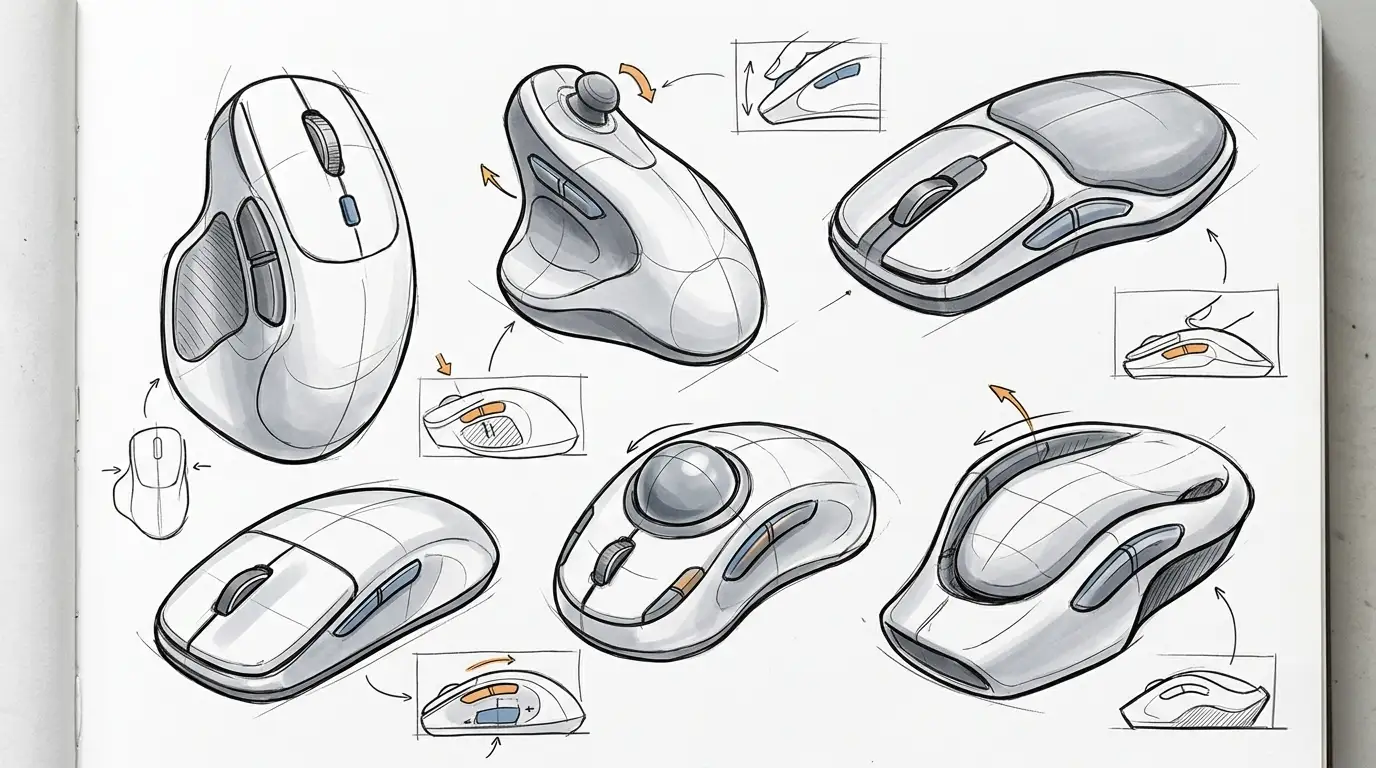
- Put multiple options on the table early, even if some feel less developed
- Evaluate each against the same criteria.
- Use quick prototypes to test principles, not polish concepts
Only once you’ve seen the landscape of possible solutions can you make an objective decision about which route has the best chance of commercial success.
4. Which route carries the least risk?
This isn’t about removing risk entirely, that’s neither realistic nor desirable.
Risk is inherent in hardware. New products require new decisions, and new decisions carry uncertainty. The goal isn’t to eliminate risk, but to understand it and choose it deliberately.
The real issue is unmanaged risk.
Teams often move forward without fully understanding the trade-offs between different options. Risk gets baked into decisions implicitly, rather than evaluated explicitly.
Where this shows up
- Choosing novel components without understanding supply stability
- Designing for tight tolerances without validating manufacturing capability
- Prioritising performance gains that introduce disproportionate complexity
In these cases, risk isn’t the problem. It’s that the risk isn’t justified or even visible.
What to do instead
Make risk part of the decision-making process:
- Identify the risks associated with each potential route
- Compare options not just on performance, but on uncertainty and exposure
- Decide what level of risk is acceptable for the stage you’re in
Then manage it deliberately:
- Reduce unnecessary risk through testing and validation
- Accept necessary risk where it creates meaningful advantage
Not all risk is bad. In many cases, it’s where differentiation comes from.
But it needs to be understood, intentional, and proportionate to the opportunity.
5. When is the right time to protect the idea?
A common mistake in hardware startups is protecting ideas too early.
At early stages, concepts are still evolving. Designs change as you test, learn, and refine. But if IP is filed too soon, it can lock you into a version of the product that isn’t fully resolved.
We often see two outcomes:
- Teams go to market with a suboptimal design because it’s the version that was protected
- Or they take the financial hit and file again once the product improves
Neither is ideal.
What to do instead
Allow space for the product to mature before committing to protection:
- Iterate freely while the concept is still forming
- Identify what is actually stable versus what is still evolving
- Begin the protection process once the design meaningfully resembles what you intend to take to market
This doesn’t mean delaying indefinitely, it means being deliberate about timing.
The goal is to protect the right idea, not just the first version of it.
In hardware, where development cycles are longer and changes are costly, that timing decision has real impact.
How working with the right design partner changes this
These challenges aren’t new, but they are difficult to navigate without experience.
The right design consultancy doesn’t just shape the product. It shapes the decisions around it.
At FLYNN, we typically get involved before things are fully defined, when the questions are still open.
That allows us to:
- Pressure-test product DNA before it’s locked in
- Connect design decisions to commercial impact early
- Explore multiple directions quickly, without overcommitting
- Identify and reduce risk in a structured way
- Align IP, engineering, and product strategy from the outset
It’s not about adding process. It’s about adding clarity at the points where it matters most.

How we help: early-stage workshops
One of the most effective ways to avoid these pitfalls is to address them early, before design and engineering decisions become fixed.
That’s why we run focused, 1 on 1 startup workshops with early-stage teams.
In a short, structured engagement, we help you:
- Define your product DNA clearly and realistically
- Map key risks across design, engineering, and manufacturing
- Explore alternative design directions
- Sense-check your commercial model
- Identify where and when IP matters
The goal is to leave with an optimised brief and product specification that will set the product up for commercial success.

The takeaway
Most hardware startups don’t fail because they lacked ambition or effort.
They fail because key decisions were made without enough clarity around what to build, how it creates value, and how it holds up in the real world.
Answer those five questions early and keep answering them as you go.
Or better yet bring them into the room before you commit to the answers.
That’s what turns an idea into something that can actually survive contact with reality.
We provide businesses with product design consultancy, industrial design, prototype design & related services.