.avif)
Do I Need a Prototype Before Contacting Manufacturers?
Short answer: If your asking this question, you probably aren’t ready to be contacting manufacturers yet.
Not because you're not ready to build, but because the decisions that determine whether your product succeeds haven't been made yet. And a manufacturer is the wrong person to help you make them at this stage.
The assumption most founders make
There's a mental model that almost every first-time product founder starts with:
Idea → Prototype → Manufacturer
It feels logical. You have an idea, you make it physical somehow, then you find someone to produce it. Job done.
The problem is that this skips the entire stage of product development where your product actually becomes good, and optimised for the market. And when you arrive at a manufacturer without having done that work, someone else ends up doing it for you, on their terms, not yours.
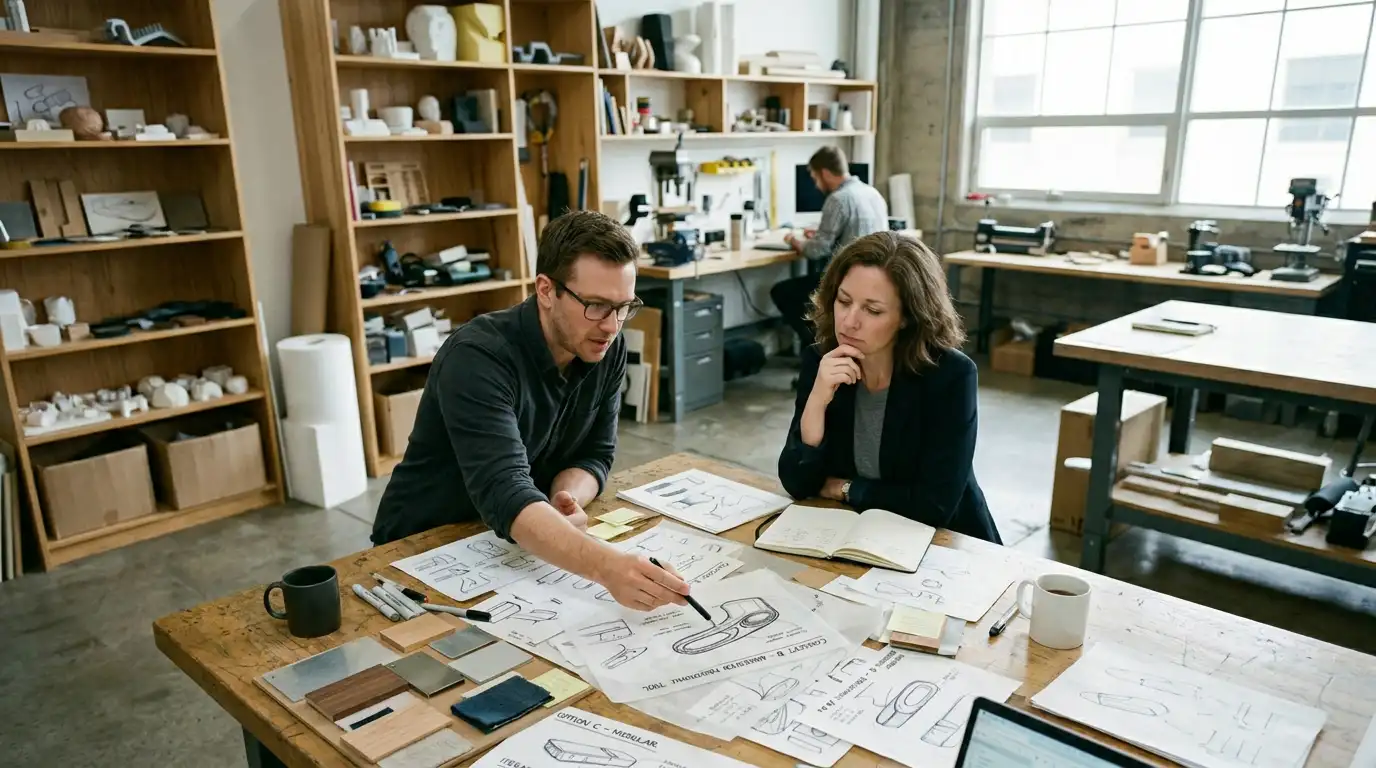
What manufacturers are actually optimised for
Manufacturers are excellent at what they do. But what they do is manufacture and that shapes everything about how they'll engage with your product, which is why using them for development can hurt your product business
- They make money from production runs, not from perfecting your idea. The commercial incentive is to get to manufacturing, not to spend time exploring whether you've landed on the right solution.
- They'll optimise for their processes, not your user or the product. The design suggestions you get will be guided by what's easiest to produce in their facility. That's not the same as what's best for your product.
- They won't explore multiple directions. A product design process might test three or four concepts before committing to one. A manufacturer will push you towards a decision quickly.
- They're not thinking about your brand. How your product looks on a shelf, how it feels in someone's hands, what it communicates about your company, none of that is a manufacturing conversation.
- When user experience and production efficiency conflict, production wins. And with a manufacturer driving development, they will conflict.
The result is a product that can be made, but may not be the right product. One that works mechanically but hasn't been tested on real users. One that's been optimised for the factory floor rather than the person it's meant for.
This isn't a criticism of manufacturers. It's just not their role.
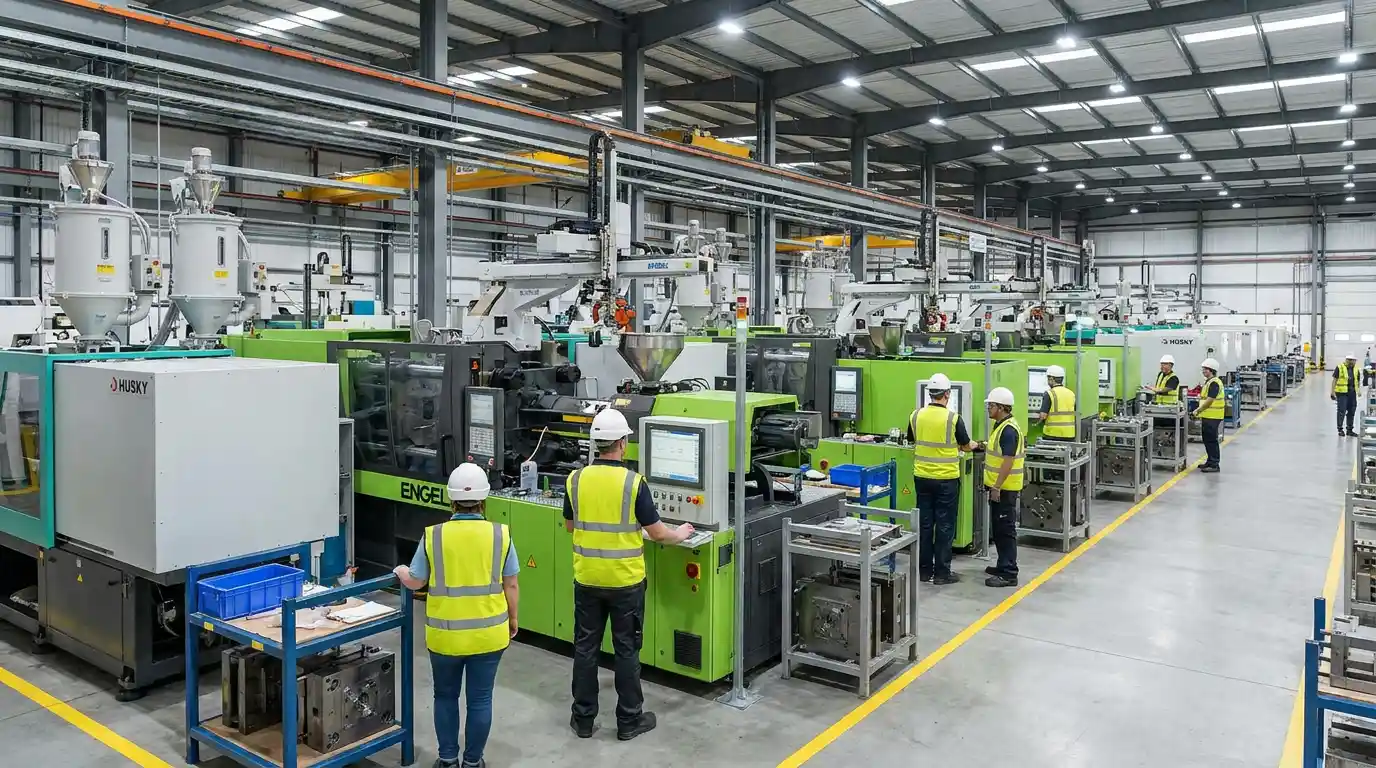
What actually needs to happen before you talk to a manufacturer
The real development journey looks like this:
Idea → Research → Concept Development → Prototyping → Testing → Design Refinement → Design for Manufacture → Manufacturer Engagement → Production
Every stage before manufacturer engagement exists for a reason. Here's what gets resolved there:
Research answers whether there's actually a market for what you're building, what problems users genuinely have, and what already exists.
Concept development turns a vague idea into defined directions, shapes, mechanisms, user interactions ,that can actually be evaluated against each other.
Prototyping and testing is where you find out what works. Not in theory. With real people.
Design refinement is where the concept becomes a product, resolved aesthetically, ergonomically, and in terms of how it communicates your brand.
Design for manufacture is where your product design team works through how to make it producible without compromising what makes it good.
By the time a manufacturer enters the picture, the product is defined. Their job is to tell you how to make it, not what to make.
Prototyping is a tool for learning, not a box to tick
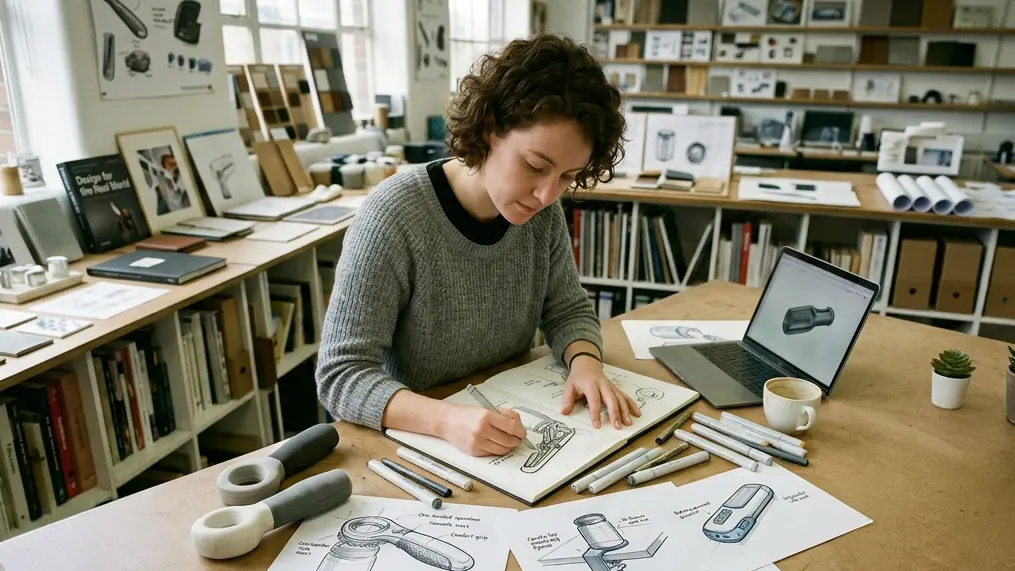
One of the most common misconceptions is treating a prototype as something you build once, show to a manufacturer, and move on from. In reality, prototyping is an ongoing process of asking questions and validating assumptions and the key is to do it as cheaply and quickly as possible until the answers give you confidence to go further.
Prototyping isn't done for the sake of prototyping. Every prototype should be answering a specific question. As soon as you have the answer, you move on.
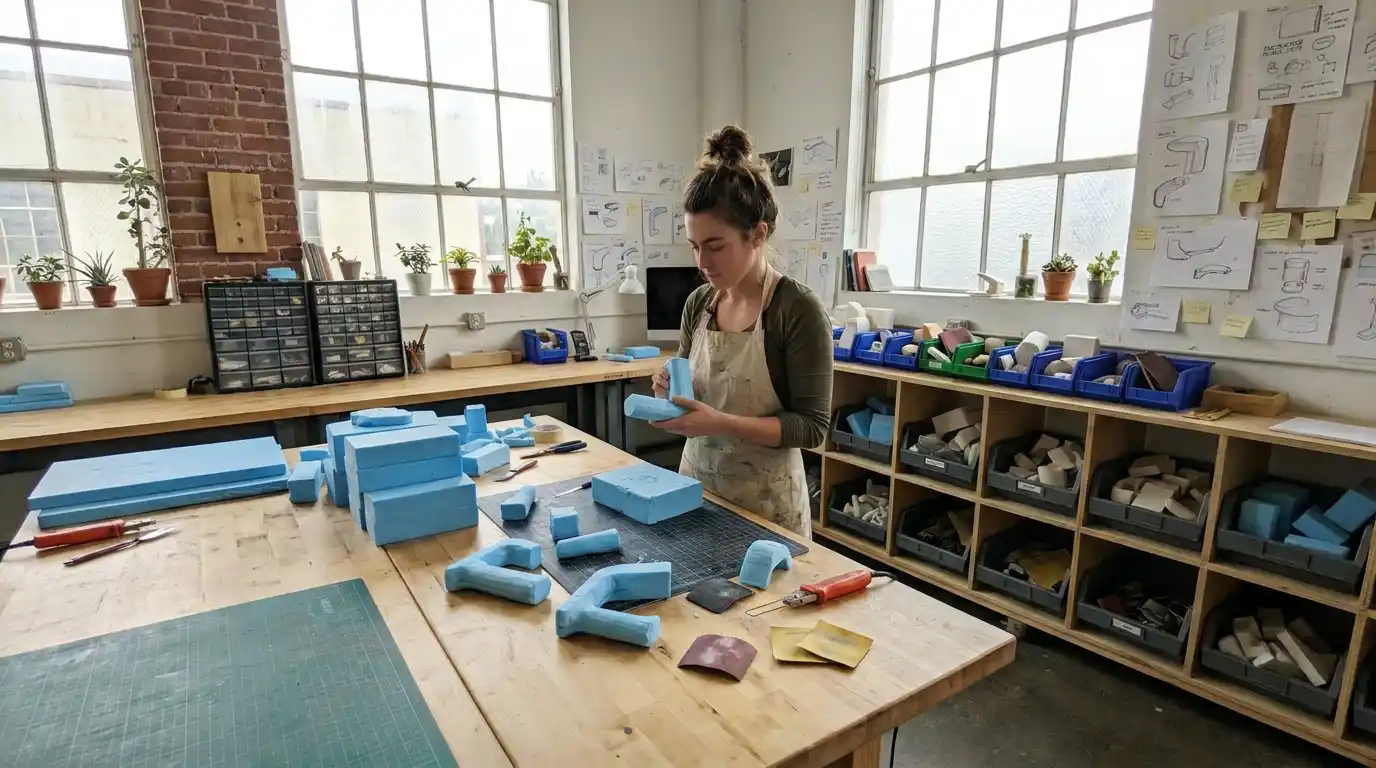
Fidelity, how refined and "finished" a prototype is, should match your level of confidence. Early on, when assumptions are untested, low-fidelity prototypes are your best friend. Cheap, fast, throwaway. Foam, card, 3D prints, rough models. Good enough to answer the question in front of you and nothing more. As confidence builds and questions get more specific, fidelity increases and so does the investment. You're not building up to a prototype. You're building through a series of them.
Sketch models & foam prototypes
Low fidelity
Does this idea make any physical sense? Is the scale right? Can someone hold it?
Foam, card, tape, rough 3D prints, made in hours, not days. The point is to get something into your hands fast. These prototypes are deliberately crude. They're not meant to impress anyone; they're meant to surface obvious problems before you've spent any real money.
Ergonomic prototypes
Low fidelity
Does this feel right in the hand? Is the size and weight correct? Can people use it without thinking about it?
Still relatively cheap to produce and test. These don't need to look finished or work mechanically, they just need to be the right shape and weight to put in front of real people and watch how they interact with them.
Appearance models
Mid fidelity
Does this look the way we intended? Does the form communicate the right things? How does it sit in its context, on a shelf, in a home, next to competitors?
More refined, but still not functional. The investment here is in understanding whether the design direction is right before committing to the engineering. Often used in brand and retail conversations.
Proof of concept prototypes
Mid fidelity
Does the core mechanism actually work? Are there engineering problems hiding in the idea?
These don't need to look like the finished product, they just need to test whether the fundamental mechanism is viable. Better to find out here than after tooling has been cut.
Looks like, Works like prototypes
High fidelity
By this stage, the design direction is settled and confidence is high. These prototypes are mimicking the final product. They are used for demonstrating your idea to potential investors, useful for marketing shots and promoting the product.
Manufacturing prototypes
High fidelity
Can this be produced consistently, at volume, at a viable cost?
The final stage before production. These are made using production-intent tooling and processes. At this point, you're not learning about the design, you're confirming the manufacturing. Everything before this point has already done the hard work.
Skipping to high-fidelity prototypes before you've answered the low-fidelity questions is one of the most expensive mistakes in product development. Handing something rough to a manufacturer and asking them to figure it out means those questions don't get answered properly, they just get answered by the wrong people, at the wrong stage, for the wrong reasons.
What a product design firm actually does for you
A top product design consultancy sits between your idea and the factory. That's where the value lives.
A good product design firm will:
- Run the research to validate your direction before you commit to it
- Develop and explore multiple design options rather than defaulting to the first feasible one
- Prototype iteratively to learn, not just to have something to show
- Test with real users and let that shape the design
- Refine the product until it's genuinely good, not just manufacturable
- Manage the design-for-manufacture process so production doesn't erode what makes your product worth buying
- Engage with manufacturers on your behalf, with a complete, resolved design in hand
Critically, they keep the design process independent of manufacturing. Manufacturer input gets fed in at the right moments, for feedback on tooling costs, production methods, component availability, but it doesn't drive the design. That distinction matters more than most founders realise until it's too late
The conversation worth having before anything else
If you're at the stage of thinking about manufacturers, the question to ask yourself isn't "do I have a prototype yet?"
It's: has my product been properly designed?
Has it been researched, tested, refined, and resolved by people whose job is to make products that work for users, not just products that can be made?
If the answer is no, a manufacturer isn't your next step. A product design firm is.
Flynn is a top product design consultancy that helps founders, startups and purpose led brands develop winning products. We take ideas from concept through to manufacture-ready design, so that by the time you're talking to factories, your product is optimised for commercial success.